Writing Cross-posted from heartwoodmushrooms.ca
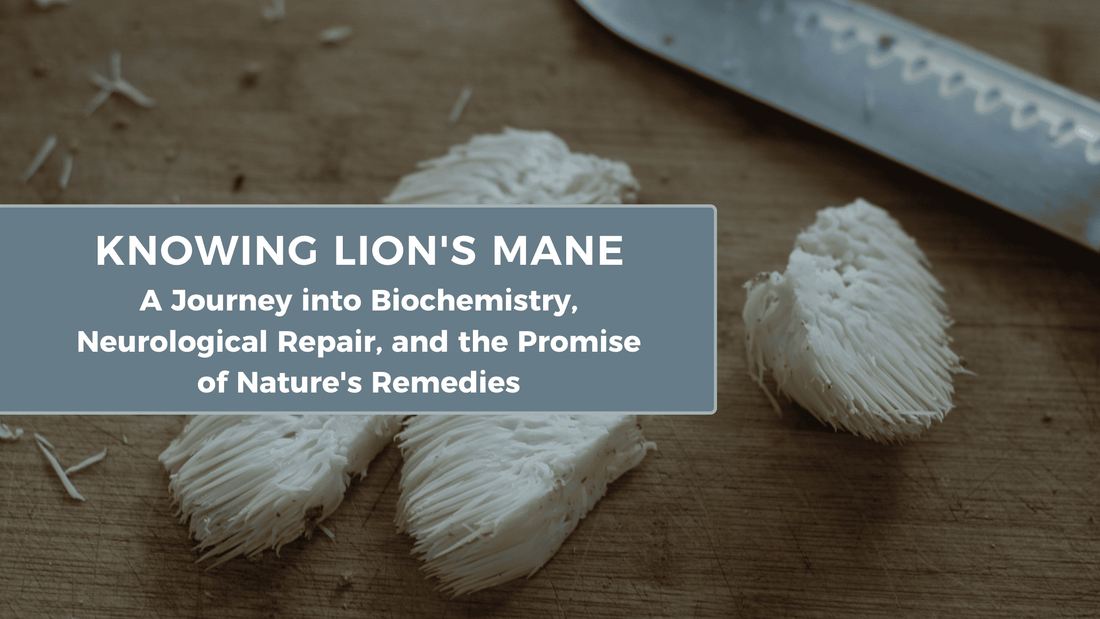
Knowing Lion's Mane: A Journey into Biochemistry, Neurological Repair, and the Promise of Nature's Remedies
Years of trial and error making lion's mane extracts at Heartwood — what I learned about extraction methods, beta-glucans, and getting to a real concussion-recovery dose.
I want people to be informed about their health and the choices available to them.
I’ve learned enough over the years that I can help the reader understand a bit more about this popular mushroom and about the products on the market.
This is about my journey with the lion’s mane mushroom.
I’ve been working with lion’s mane for years now, but it’s been supercharged in the past year as I’ve been gifted with amazing feedback and wisdom.
The ‘why’ for me at the core is for my friend who has been suffering with post-concussion symptoms for years, and those who are experiencing similar. Symptoms can last years and are often debilitating. I want people to know that lion’s mane can be a helpful aid in recovery. A lot of the lion’s mane on the market is less potent than a clinical concussion-recovery dose. Most people don’t know that. They see “mushroom coffee” and don’t know which mushrooms do what, what amounts they’re taking, how that mushroom was extracted, and what the final compounds are.
My daughter was violently ill one Friday night. Fever, puking for hours. So I took her to emerge for kids. It was about 9pm when we arrived. The waiting room was pretty full — I counted about 20 children with their caretakers. 6 other parents held their young child who seemed to be sick like my daughter. The other 14 were boys, age 10–15. After overhearing some conversation, I learned that all of them were there from head-trauma related impacts from playing hockey earlier that night.
After listening to this story, I let the ramifications hit me. I found this article by the CDC that states “In 2020, 6.8% of children aged 17 years and under had symptoms of concussion or brain injury.”
There was a time when I didn’t see value in plant — let alone mushroom — medicines. They were less effective versions of compounds that a lab could make. I was very analytical, which lent itself to studying engineering. While that mode of being is effective in some scenarios, it’s ultimately limiting in others. I should be able to feel something when I take a medicine, no?
This was still the state I was in when Heartwood Mushrooms started making mushroom extracts. The initiative was spearheaded by my then-business partner and co-founder. I knew that she believed in them, and I had read some studies affirming their benefits. To be honest, I always had a hard time selling them because I hadn’t felt the effects myself. They sold though, and we got lots of positive feedback.
We made them as potent as we could with the equipment and knowledge available to us. It was a simple dual extraction: soak the dried mushrooms in a jar of 100-proof alcohol for a month and press it. Get a new batch of dried lion’s mane and slow-cook them in water for 8–12 hours and press that. Combine both the alcohol and water down to 25 % ABV. This was the recipe for years.
At one market, a herbalist asked what proof alcohol I used.
“100,” I responded.
“You should use 180-proof. It will lyse [rupture] the cell wall and you can extract the compounds. Also, use the same material in the water extraction. You’ll get more because the cells have already been broken.”
Alright, noted. This was fantastic information. I couldn’t help feeling like I had been peddling snake oil though. There was a much better way to do this, but I didn’t know.
I switched from 100 proof to 180 proof alcohol. I also purchased an extraction machine, typically used in the cannabis industry. It looks like a bulky kettle on the outside. On the inside, it’s well-insulated and has a heating element and a programmable immersion blender. You can set the temperature and the time. This machine will stir, blend and agitate the mushroom material and, in theory, get a better extraction. I also bought a tincture press because I was only able to squeeze out about 50 % of the solvent by hand. This let me get up to 85–90 % of the solvent back out of the material. I’d put the jar in a freezer and the fat molecules solidified to the sides of the jar. Then I’d pour out the alcohol extract into a clean jar, leaving the fat molecules behind. I cooked the lion’s mane in a slow cooker for 12 hours and then pressed it. The first batch was super cloudy so I filtered it a bunch of times, thinking it would make a nicer-looking product. A herbalist friend of mine said I was filtering out beta-glucans. So I stopped doing that. This was an improvement over the original recipe and process.
I started making whole lion’s mane powder and selling it to my friend who had been struggling with post-concussion symptoms for years. I erroneously made the assumption that the whole lion’s mane as a powder would be better for you than the extract. Less processing = better for you. Anyways, I was happy with it, he was happy with it, and even noted small improvement in his condition when he took it. Improvement that had been elusive to him for a long time.
A few months later, I was talking to another friend. He had also been on a concussion-recovery path and had done extensive research into different compounds that could help him.
He said that whole-mushroom powder is not a very effective way to deliver the neurological-repairing compounds. The chitin in the cell wall is extremely tough and the human digestive system can’t break it down.
Ahhh… ok. This was the same lesson the herbalist taught me.
I hate the feeling of making and selling something far inferior to what I could make.
What actions would I need to take for me to feel absolutely confident and proud of a Heartwood extract?
Why was I so emotionally activated by these encounters? It’s normal to not be good at the start and to learn over time. I think I was, and still am to some degree, wearing the mistrust I felt toward people who pull the wool over people’s eyes with dishonest health products. I don’t want to be seen as untrustworthy. I want people to be healthy and happy. It just doesn’t sit ok with me to take someone’s money knowing I could have done better.
What’s in it for me? Why should I solve this problem? The people I love will be healthier and happier.
I began doing my own research. I became obsessed with delivering a potent concussion-recovery dose of lion’s mane at an affordable price. A clinical concussion-recovery dose of lion’s mane is 1000–3000 mg/day. I set the average as a target — 2000 mg/day for 30 days. I crunched the numbers and calculated how much of my own lion’s mane extract I would need to take to reach that. 16 doses was the answer. That means I would go through an entire bottle every 4 days.
Anyways, for science, I began taking 2000 mg every morning in my coffee. Let me tell you, the results were incredible. I felt so clear in my mind, so relaxed, so focused. For the first time I felt the effects of the lion’s mane. Woah, this is great!
Now, let’s get a lot more into a bottle.
I did the same dual extract as described above, but I reduced the volume of both the alcohol and water extracts separately by 87.5 % (or 1/8 of the original volume) in a slow cooker before combining them.
The normal extract is a 1:8, so by reducing the volume by a factor of 8 I figured the result would be a 1:1 extraction ratio — 1000 mg of mushroom for 1 mL of liquid. In our 60 mL bottles, this would give 2 months at 1000 mg/day or 1 month at 2000 mg/day. I gave a few bottles to friends to try out. I’ve been trying it myself.
I haven’t felt the intensity of lion’s mane from this extract. While it looks amazing and dark and potent, I don’t feel much.
I met Grant, a mushroom-extraction enthusiast and founder of Greenfoot.ca, at the 2023 Royal Winter Fair. He has been studying mushroom extracts for many years and is an absolute vault of knowledge and information. He told me that soft-bodied mushrooms, like lion’s mane, don’t need large complex apparatuses or multiple solvents. Just cooking it in water would do.
The next recipe I tried involved only water. I stewed the lion’s mane in a slow cooker for 12 hours. Next, I blended all of it together into a slurry. I placed that slurry on trays and dehydrated until cracker-dry. Once dry, I broke up the pieces (which were surprisingly hard and dense). I blended them into a powder. My thought with this is that the medicine will extract a lot easier in hot water for applications like tea and coffee. The powder had a large range of particle sizes, from the finest powder to coarse sand. My blender sounded like it was grinding up gravel. I have been mixing this powder with cumin-fennel-coriander and simmering it all together for a few minutes into a kind of tea which helps brain and digestion. If I can find better ways to grind it down, it may prove to be a more useful product.
As I was writing this, I received an email from Grant where he was responding to the outcome of my above experiment.
Nammex makes the Lion’s Mane extract where they briefly cook the mushroom and then dry it and powderize it. And when it comes to soft tissue mushrooms, I have to agree with them that it’s the best way to go. But you are going to need a proper herb grinder. There’s no way around that. They grind stuff down to 60 microns or smaller. For perspective, paper coffee filters filter stuff about 20 to 30 microns. So that pretty darn small.
I went out and purchased an electric herb and grain mill that can turn our dried mushroom substances into a fine powder. I’m not sure how large the particles are after this process but they do tend to clog coffee filters, so I assume we’re getting close to the desired size.
Recently, as of mid-June 2024, I’ve sent out a few small amber glass jars with this powder in them to a few friends who are recovering from concussions. These jars hold about 45 g of lion’s mane powder, which is quite close to the 2000 mg/day-for-a-month quantity I was aiming for.
We’ll see how this goes.
My latest experiment was another water-only process. I cooked the lion’s mane for 12 hours and then I pressed it.
Without filtering, I set up shallow trays and evenly distributed the decoction between the sheets and dehydrated it for 2 days. I was left with a tough, tacky, dark-amber resin on the bottom of the trays.
It took some effort, but I got almost all of the resin out and into a jar. I tried washing the trays with 180-proof alcohol to get the rest off, but absolutely none of the resin was lifted by the alcohol.
This indicates to me that I missed all of the alcohol- or fat-soluble compounds. I like this resin, because it dissolves in hot water easily.
I can put it in my coffee. I’d like to do the same with the alcohol extract, but I need a way to recover the alcohol rather than just boiling it all off.
I feel like I know less the more I learn, which is a sign I’m heading in the right direction.
I’m still confused about how mushroom extracts are measured.
A 1:8 means that 1 mg of dried mushroom was extracted in 8 mL of water/solvent. But this doesn’t translate into the amount of total dissolved solids. For example, using 100-proof vs 180-proof alcohol in similar volumes will extract different amounts of compounds. The dried mushroom piece size, the duration of the extraction, and how much or how often it was agitated all affect how much of what gets extracted.
With regards to the concussion-recovery dose of 1000–3000 mg per day — does that mean of the dried-mushroom equivalent or that mass in extract? Those are two very different numbers.
The size of the beta-glucans, the large complex sugars we want, determines when and how they are extracted. They likely also have different properties and interactions. What would a short and intense extraction look like compared to a ‘long-tail’ extraction where 99 % of the compounds were extracted and consumed in all their complexity?
How does temperature affect the properties of these different beta-glucans?
I want a way to empirically test the potency and make-up of my extracts. As of right now, I have some idea of what’s happening at the biochemistry level.
I think I’m still far from being an expert about lion’s mane, but I know a lot more now.
For the reader, here are the Coles Notes:
- Consume 1–3 g/day of dried lion’s mane for concussion recovery
- The lion’s mane must be extracted, cooked, or released in some way so the body can absorb it
- Mushrooms are about 90 % water, so the equivalent is 10–30 g of fresh lion’s mane per day
I’ve been having fun with this and I’m going to keep at it.
I hope this was helpful to you.